How neuroscience-backed stretching protocols from Huberman Lab Essentials line up with proprioceptive mobility training.
Inspired by Huberman Lab Essentials, Andrew Huberman, PhD, Stanford School of Medicine
Most of us treat stretching like a chore we tack onto the end of a workout — a few toe touches, a quick lunge, done. But in a recent episode of Huberman Lab Essentials, Stanford neurobiologist Andrew Huberman makes a compelling case that flexibility isn’t really about muscles at all. It’s about your nervous system.
At Stick Mobility, that’s a principle we’ve built our entire training philosophy around. Real, lasting mobility gains come from teaching your nervous system that a new range of motion is safe — not from forcing tissue to stretch further than it wants to go. Huberman’s breakdown of the neuroscience behind flexibility lines up closely with what we see on the training floor every day, and it’s worth unpacking for anyone serious about improving how their body moves.
Your Nervous System Is Running the Show
Huberman explains that flexibility training involves three interconnected systems: the nervous system, the muscles, and the connective tissue. Of the three, the nervous system calls the shots.
Inside your muscles, sensory structures called muscle spindles constantly monitor how much a muscle is being stretched. If a limb moves into a range of motion your nervous system perceives as risky, those spindles trigger a protective reflex — the muscle contracts to pull the limb back into a “safe” zone. It’s the same basic mechanism behind the knee-jerk reflex you’ve experienced at the doctor’s office.
A second safety system, the Golgi tendon organ, sits near the tendons and monitors load rather than stretch. If you try to lift something dangerously heavy, these sensors can shut down the motor neurons driving the muscle entirely, protecting your joints and tendons from tearing.
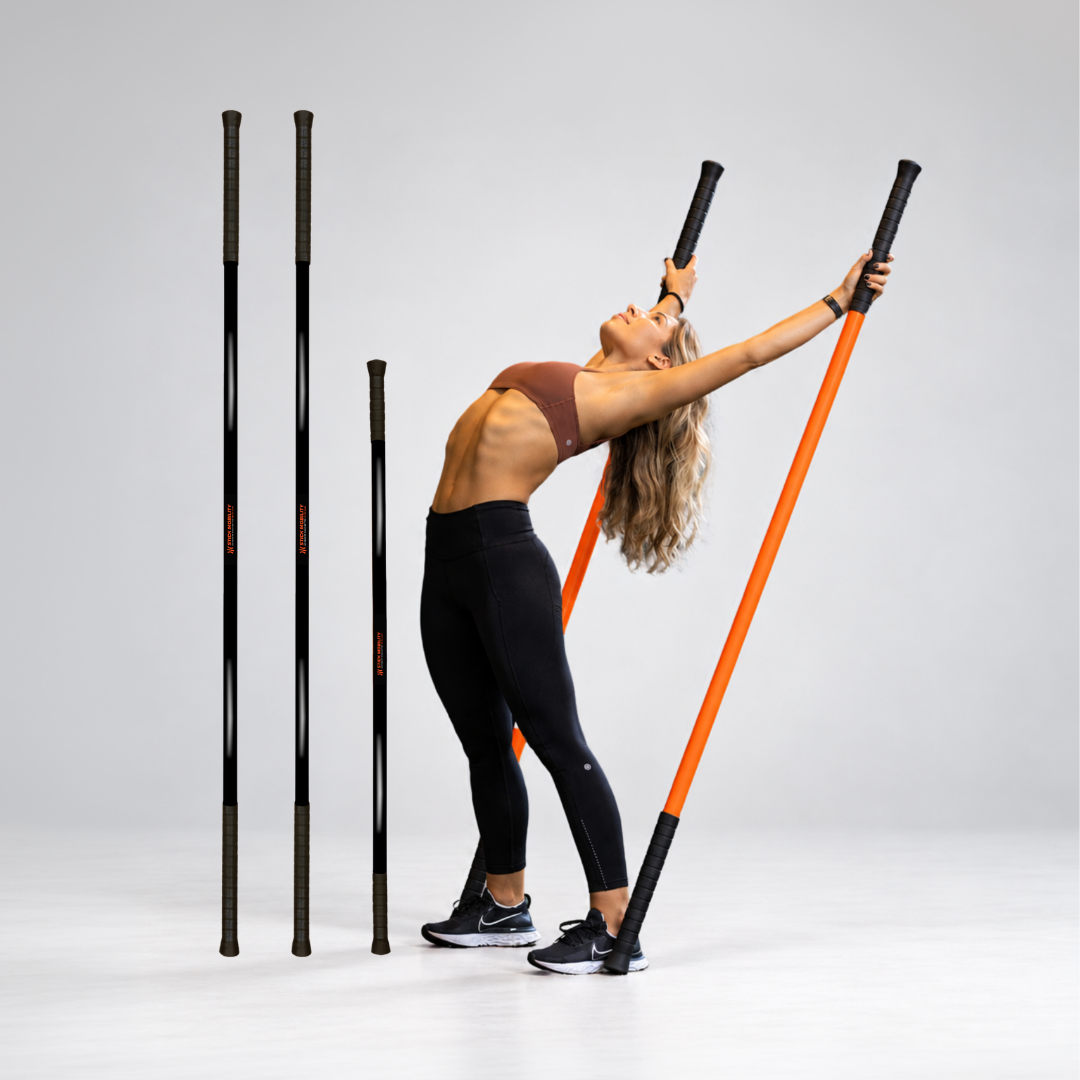
Here’s the practical takeaway: your range of motion is gated by your nervous system’s perception of safety, not just by tissue length. This is exactly why mobility tools that emphasize controlled, proprioceptive feedback — like a Stick Mobility Training Stick — can outperform static stretching alone. When you give your nervous system clear information about where your body is in space, it’s more willing to relax into new ranges of motion instead of slamming the brakes.
The Brain Region You’ve Never Heard Of (But Should Know)
One of the more fascinating parts of the episode covers a structure called the insula, specifically a population of large neurons called von Economo neurons, which appear to be uniquely enriched in humans. These neurons sit at the intersection of interoception — your brain’s read on what’s happening inside your body — and your ability to consciously override protective reflexes.
This is the neural basis for “relaxing into a stretch.” When you choose to lean into discomfort because you’ve decided it’s purposeful rather than threatening, these circuits can shift your nervous system from a stressed, sympathetic state toward a calmer, parasympathetic one — quieting some of those protective spindle reflexes in the process.
It’s also why breath, intent, and controlled tension matter so much in mobility work. Mobility isn’t just mechanical; it’s a conversation between your brain and your body about what’s safe.
Static Stretching Still Wins for Long-Term Range of Motion
Huberman reviews research comparing dynamic, ballistic, static, and PNF (proprioceptive neuromuscular facilitation) stretching. While all styles produced some improvement over time, static stretching held for roughly 30 seconds per rep showed the most consistent, statistically significant gains in long-term range of motion — even outperforming PNF in some comparisons.
The research-backed protocol he highlights breaks down simply:
• Hold each static stretch for about 30 seconds
• Perform 2–4 sets per muscle group
• Total at least 5 minutes of stretching time per muscle group, per week
• Spread sessions across 5 or more days per week
That’s a low bar to clear — roughly 90 seconds of focused stretching per muscle group, done consistently, beats occasional marathon stretching sessions. Consistency, not intensity, drives the adaptation.
Warm Up First, Stretch Second
One detail that’s easy to overlook: stretching cold tissue invites injury. Huberman notes that if you’re already warm from training, static stretching at the end of a session is ideal. If you’re stretching cold, 5–10 minutes of light cardio or calisthenics beforehand raises core temperature enough to stretch safely.
This is part of why we coach mobility work as a bridge between warm-up and training — using dynamic, loaded movement patterns first to prime the nervous system before asking tissue to lengthen under control.
Low-Intensity Stretching Beats Pushing Into Pain
Perhaps the most counterintuitive finding in the episode: stretching gently outperforms stretching hard. Huberman cites a six-week study on recreational dancers comparing low-intensity “micro-stretching” (held at roughly 30–40% of perceived intensity, well short of pain) against moderate-intensity static stretching (around 80% intensity, near the pain threshold).
The result? The low-intensity group saw greater improvements in active range of motion — the kind of flexibility you can actually access during real movement, not just while lying passively on a mat.
This finding reinforces something we emphasize constantly in mobility coaching: chasing the deepest possible stretch isn’t the goal. Training your nervous system to trust a controlled range of motion, repeated often, builds more durable flexibility than occasional pain-threshold stretching ever will. A tool that lets you dial in exactly how far you go — rather than relying on gravity or a training partner to push you — makes it far easier to stay in that effective, low-intensity zone.
What Yoga Teaches Us About Pain Tolerance
Huberman also references a study published in Cerebral Cortex examining brain structure in yoga practitioners. Compared to non-practitioners, experienced yoga practitioners showed roughly double the pain tolerance on thermal testing, along with measurably greater gray matter volume in the insula.
The implication isn’t that yoga is magic — it’s that consistent, intentional practice of moving through discomfort (safely) reshapes how the brain interprets and tolerates that discomfort over time. The same logic applies to any structured mobility practice: showing up consistently changes not just your tissue, but your relationship with discomfort itself.
Putting the Research Into Practice
Pulling this together, the science points to a few clear principles for anyone building a flexibility or mobility routine:
1. Warm up before you stretch — even a few minutes of light movement matters.
2. Favor static holds of around 30 seconds, performed in 2–4 sets per muscle group.
3. Stretch most days of the week rather than occasionally for long sessions.
4. Stay well below your pain threshold — low-intensity, controlled stretching consistently outperforms pushing to the edge.
5. Use tools that give your nervous system clear feedback about position and control, since flexibility gains depend as much on neural trust as on tissue length.
That last point is where mobility tools like the Stick Mobility Training Stick come in. By providing a stable, external reference point, they help your nervous system map exactly where a joint is moving — which, per Huberman’s own framework, is precisely the kind of input that allows protective reflexes to relax and real range of motion to follow.
Flexibility isn’t something you force. It’s something you teach your nervous system to allow. Train accordingly.
Sources & Further Reading
This article draws on research and commentary from the Huberman Lab Essentials episode on the science of flexibility and stretching, hosted by Andrew Huberman, PhD, professor of neurobiology and ophthalmology at Stanford School of Medicine. Follow Huberman Lab on Instagram, X, Threads, Facebook, TikTok, and LinkedIn, or subscribe to the Huberman Lab Newsletter.
Ready to put the science into practice? Explore Stick Mobility’s training tools and coaching resources built around exactly this kind of neuroscience-backed mobility training.